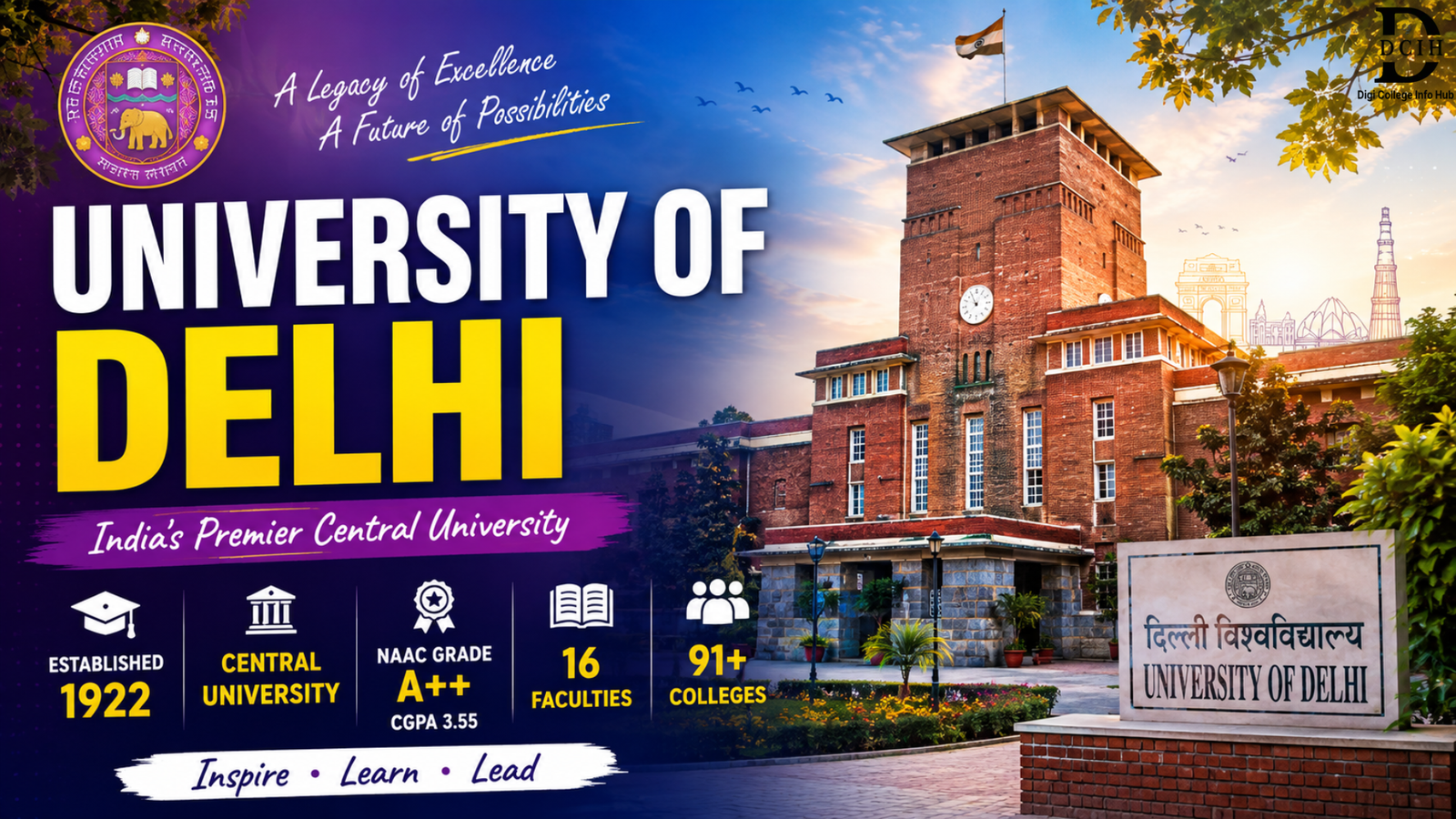
The University of Delhi (DU), popularly known as Delhi University, is one of India’s most prominent public central universities. Established in 1922, the university has developed into a major centre for higher education, teaching, research, and academic excellence. Its North Campus is located in Delhi, with the university’s official address listed as North Campus, Delhi – 110007.
For students looking for undergraduate, postgraduate, doctoral, professional, and other higher-education opportunities, DU offers a wide range of academic programmes through its faculties, departments, colleges, and recognised institutions.
University of Delhi – Overview
| Particular | Details |
|---|---|
| University Name | University of Delhi |
| Popular Name | Delhi University (DU) |
| University Type | Central University |
| Established | 1922 |
| Location | North Delhi, Delhi |
| PIN Code | 110007 |
| Recognition | UGC-recognised Central University |
| UGC Status | 2(f) & 12(B) |
| NAAC Accreditation | A++ Grade, CGPA 3.55 |
| Faculties | 16 |
| Academic Departments | 86 |
| Colleges | 91 listed by the university |
| Official Website | www.du.ac.in |
Note: University statistics can change as institutions, programmes, and administrative structures are updated. The current DU website lists 16 faculties, 86 departments and 91 colleges.
About the University of Delhi
The University of Delhi was established in 1922 as a unitary, teaching and residential university through an Act of the Central Legislative Assembly. It initially began with three colleges, two faculties and around 750 students. Over the decades, DU expanded significantly and became one of India’s largest and most recognised universities.
The university’s early academic structure consisted of the Faculties of Arts and Science and eight departments, including English, History, Economics, Sanskrit, Arabic, Persian, Physics and Chemistry. The university’s historical timeline records the Delhi University Act coming into force on 1 May 1922.
Today, DU brings together a large network of faculties, departments, colleges and other recognised institutions. Its academic environment attracts students and faculty members from different parts of India and from abroad.
University of Delhi Campus
The University of Delhi has a strong presence across Delhi. Its North Campus is one of the university’s best-known academic hubs and is associated with several major departments, colleges, libraries and student facilities.
The university also has a South Campus and colleges and institutions distributed across different parts of Delhi. The official university website lists the North Campus at Delhi – 110007 and the South Campus at Benito Juarez Marg, South Moti Bagh, New Delhi.
North Campus
Address: University of Delhi, North Campus, Delhi – 110007.
The North Campus area is surrounded by several well-known DU colleges and academic departments. It is an important destination for students pursuing undergraduate and postgraduate education at the university.
Academic Structure of Delhi University
DU has a broad academic structure covering humanities, social sciences, sciences, commerce, management, technology, education, law, music, fine arts and other disciplines.
The current university website lists 16 faculties and 86 academic departments. The university also provides information on courses and programmes through its official academic resources.
Major Areas of Study
- Arts and Humanities
- Social Sciences
- Science
- Mathematical Sciences
- Commerce and Business Studies
- Applied Social Sciences and Humanities
- Management
- Computer Science and Technology
- Education
- Law
- Music and Fine Arts
- Interdisciplinary and Applied Sciences
- Vocational and professional programmes
Popular Courses at University of Delhi
Delhi University offers a wide selection of undergraduate, postgraduate, doctoral and other programmes. Course availability and admission requirements differ by programme and college.
Popular Undergraduate Courses
- B.A. (Hons.) English
- B.A. (Hons.) Economics
- B.A. (Hons.) Political Science
- B.A. (Hons.) History
- B.A. (Hons.) Sociology
- B.A. (Hons.) Psychology
- B.A. Programme
- B.Com.
- B.Com. (Hons.)
- B.Sc. programmes
- B.Sc. (Hons.) programmes
- B.Tech. programmes
- Other specialised and vocational programmes
DU’s undergraduate admission information covers programmes in areas such as languages, arts and social sciences, science, mathematics and technology, commerce and management, vocational studies, music and fine arts, and education.
Postgraduate Courses
Students can pursue postgraduate programmes across numerous disciplines through the university’s departments and affiliated colleges. Depending on the programme, admission may involve university-prescribed entrance and/or merit-based processes.
- M.A. programmes
- M.Com. programmes
- M.Sc. programmes
- Master’s programmes in specialised disciplines
- Professional postgraduate programmes
- Other postgraduate programmes offered through DU departments and colleges
Ph.D. Programmes
The University of Delhi also provides opportunities for doctoral research across a wide range of academic disciplines. Individual departments publish admission notices, eligibility requirements, schedules and other research-related information.
University of Delhi Admission 2026-27
Students seeking admission to DU should always check the latest notification and admission portal because eligibility criteria, registration schedules, entrance requirements, programme combinations and other admission rules can change from one academic session to another.
The official DU website currently provides information for the 2026-27 admission cycle and directs applicants to the relevant admission resources.
Undergraduate Admission
For many undergraduate programmes, students should carefully check the applicable admission route, eligibility conditions, subject requirements and entrance examination requirements mentioned in the latest DU admission information.
Applicants should also review the programme and college combination carefully before submitting preferences.
Postgraduate Admission
Postgraduate admissions are conducted according to the university’s current admission rules and programme-specific requirements. Candidates should check the latest postgraduate admission notification for entrance, eligibility, registration and counselling details.
Ph.D. Admission
Doctoral admissions are handled through the university’s departments and applicable admission procedures. Candidates should refer to the concerned department and the official DU admission notifications for current eligibility and selection details.
University of Delhi Colleges
One of the biggest strengths of Delhi University is its extensive college network. The official university college directory includes institutions located across different parts of Delhi.
Some well-known colleges associated with DU include:
- St. Stephen’s College
- Hindu College
- Shri Ram College of Commerce
- Hans Raj College
- Miranda House
- Lady Shri Ram College for Women
- Ramjas College
- Kirori Mal College
- Daulat Ram College
- Gargi College
- Shri Guru Tegh Bahadur Khalsa College
- Shaheed Sukhdev College of Business Studies
- Atma Ram Sanatan Dharma College
- Delhi College of Arts and Commerce
- Deshbandhu College
The university’s official directory contains a much larger list of colleges and recognised institutions. Students should verify the current affiliation and programme availability before applying.
University of Delhi Accreditation
The University of Delhi has received an A++ grade from NAAC with a CGPA of 3.55 in its second accreditation cycle. This is one of the university’s important quality and accreditation milestones.
Students researching DU should distinguish between university-level accreditation and the accreditation or recognition status of individual colleges and programmes. The relevant college or department should be checked separately where necessary.
Research and Academic Excellence
Research is an important component of Delhi University’s academic ecosystem. Its departments have contributed to scholarship in areas including sciences, humanities, social sciences, commerce, law and other disciplines.
The university’s long academic history includes distinguished scholars and faculty members who have contributed to teaching and research in India. Its official history also highlights academics such as D. S. Kothari, T. R. Seshadri, P. Maheshwari and M. L. Bhatia.
Student Life at Delhi University
Student life at DU extends beyond classroom learning. Students can participate in societies, cultural activities, academic events, sports, seminars, conferences, student clubs and other co-curricular activities.
The university’s large college network creates a diverse student environment. Each college may have its own societies, facilities, events and student activities.
Library and Learning Resources
Delhi University provides academic and library resources to support teaching, learning and research. The university’s history records that the Delhi University Library began with a collection of 1,380 gifted books in its early years.
Today, students and researchers can access institutional libraries, departmental resources and digital academic materials depending on their programme and institution.
School of Open Learning
The University of Delhi also provides open and flexible learning opportunities through its School of Open Learning (SOL). For the 2026-27 academic session, the SOL website lists undergraduate, postgraduate and skill courses and provides online admission facilities.
The School of Open Learning can be an option for students who require a more flexible mode of higher education. Applicants should check the current SOL prospectus and programme-specific eligibility before applying.
University of Delhi Facilities
Facilities available to students vary according to the college, department and campus. Depending on the institution and programme, students may have access to:
- Central and college libraries
- Departmental laboratories
- Computer and digital facilities
- Classrooms and lecture halls
- Hostel facilities where available
- Sports facilities
- Student activity and society spaces
- Health and wellness facilities
- Academic support services
- Student grievance support
- Career and placement support through applicable institutions
Placements and Career Opportunities
Career opportunities at Delhi University depend significantly on the course, college, academic performance, skills, internships and the student’s career goals. Many DU colleges organise placement drives, internships, career sessions and recruitment activities.
Students interested in placements should check the individual college’s placement cell because recruitment opportunities and participating organisations can differ considerably between colleges and programmes.
Why Choose University of Delhi?
- Long academic legacy: DU was established in 1922 and has a history spanning more than a century.
- Wide academic choice: Students can choose from programmes across numerous disciplines.
- Large college network: DU has a substantial network of colleges and recognised institutions across Delhi.
- Strong academic ecosystem: The university combines faculties, departments, colleges and research institutions.
- Excellent accreditation: DU has received the NAAC A++ grade with a CGPA of 3.55 in its second accreditation cycle.
- Student diversity: Students from different regions and backgrounds study at the university.
- Delhi location: Its location provides students with access to a major metropolitan environment and a broad employment ecosystem.
University of Delhi Eligibility
Eligibility depends on the specific programme. Undergraduate, postgraduate, doctoral and professional programmes can have different academic requirements.
Students should not rely on general eligibility information when applying. The latest official admission bulletin should be checked for:
- Required educational qualification
- Required subjects in qualifying examinations
- Minimum marks or other academic conditions
- Entrance examination requirements
- Reservation and category rules
- Programme-specific conditions
- Documents required for registration
Documents Commonly Required for Admission
The exact document list depends on the programme and admission process. Applicants may generally need documents such as:
- Class 10 certificate or equivalent document
- Class 12 marksheet and certificate for UG applicants
- Graduation marksheets and degree/certificate for PG applicants
- Valid identity proof
- Passport-size photographs
- Category certificate, where applicable
- Transfer or migration-related documents, where applicable
- Entrance examination-related documents, where applicable
Candidates should verify the current document requirements from the official admission portal before completing the application.
How to Apply for University of Delhi Admission
- Visit the official University of Delhi website.
- Open the current admission section.
- Read the latest admission notification and prospectus.
- Check programme-wise eligibility.
- Complete the applicable registration process.
- Upload the required documents and information.
- Pay the applicable application fee, if required.
- Submit the application before the deadline.
- Keep the application form and payment confirmation for future reference.
- Follow the official website for subsequent admission, allocation, counselling or verification updates.
University of Delhi Address
University of Delhi
North Campus
Delhi – 110007
India
The university’s official website lists the North Campus address as Delhi – 110007.
Official Website
Students should use the official University of Delhi website for the latest information regarding admissions, examinations, courses, results, notifications, colleges and university policies.
Visit the Official University of Delhi Website
Frequently Asked Questions (FAQs)
1. Is University of Delhi a Central University?
Yes. The University of Delhi is a central university established in 1922 through an Act of the Central Legislative Assembly.
2. Where is University of Delhi located?
The university’s North Campus is located in Delhi, with the PIN code 110007. DU also has a South Campus and a large network of colleges across Delhi.
3. When was Delhi University established?
The University of Delhi was established in 1922. The Delhi University Act came into force on 1 May 1922.
4. How many colleges are there in Delhi University?
The current DU website lists 91 colleges. The university’s college network and institutional structure can change, so applicants should check the latest official directory.
5. What is the NAAC grade of Delhi University?
University of Delhi has received the NAAC A++ grade with a CGPA of 3.55 in its second accreditation cycle.
6. What courses are available at Delhi University?
DU offers programmes across arts, humanities, social sciences, science, mathematics, technology, commerce, management, education, music, fine arts and other fields. The exact programmes available depend on the department and college.
7. Does Delhi University offer postgraduate programmes?
Yes. The university offers postgraduate programmes across multiple academic disciplines through its departments and colleges.
8. Does Delhi University offer Ph.D. programmes?
Yes. Doctoral research opportunities are available across different departments and disciplines, subject to the applicable admission process.
9. Does DU have open learning programmes?
Yes. The University of Delhi operates the School of Open Learning, which provides UG, PG and skill-oriented programmes. The SOL website currently lists admissions for the 2026-27 academic session.
10. Where can students find the latest DU admission information?
Students should visit the official University of Delhi website and the relevant admission portal for the latest notifications, eligibility criteria, schedules and application instructions.
The University of Delhi is one of India’s leading central universities, combining a long academic heritage with a large and diverse modern higher-education ecosystem. From its beginning with three colleges and around 750 students in 1922, the university has grown into a major institution with numerous faculties, departments and colleges.
For students planning to study at DU, the most important step is to check the latest official admission notification and programme-specific eligibility requirements before applying. Since admission rules, courses, dates and college-level details can change, the official DU website should always be treated as the primary source for current information.
University: University of Delhi
Type: Central University
Address: North Campus, Delhi – 110007
UGC Status: 2(f) & 12(B)
NAAC: A++ (CGPA 3.55)
Official Website: http://www.du.ac.in/
Author
About the Author